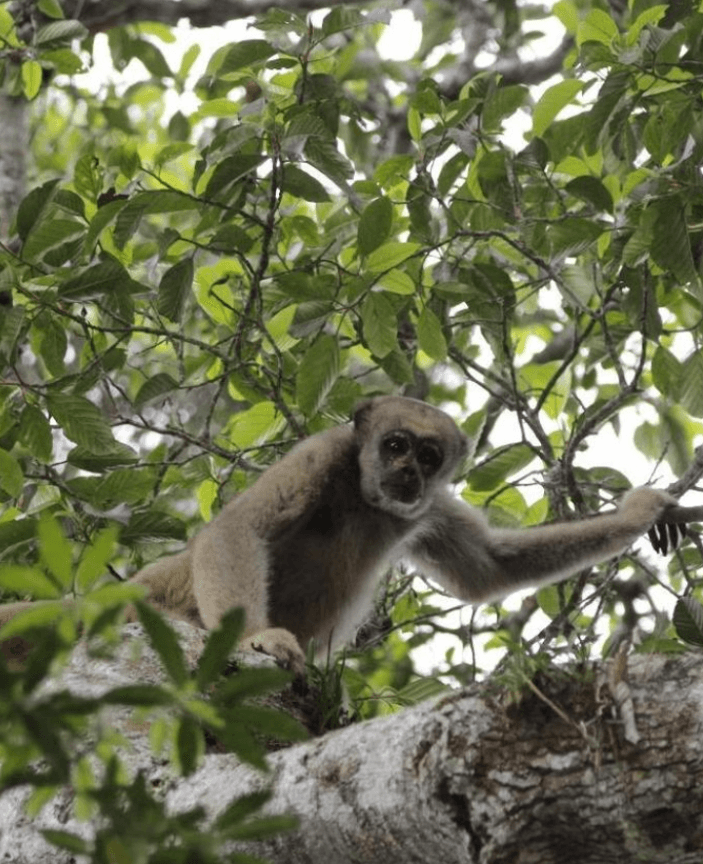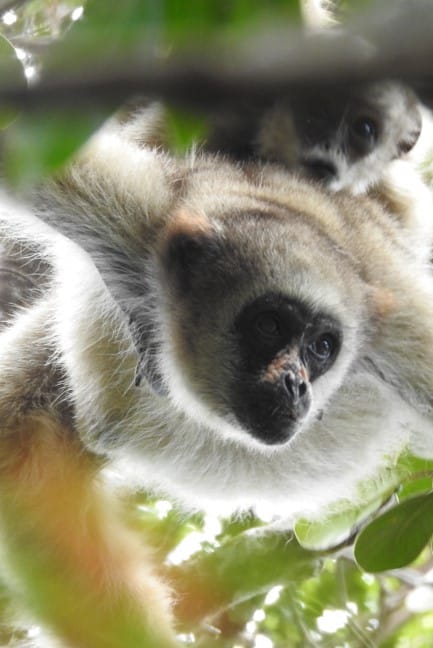
Meet SOS Muriqui
The tool that connects communities and protects muriquis at risk
Did you know that muriquis, these amazing primates of the Atlantic Forest, don't always stay in their groups? Some females migrate between populations and end up isolated, putting them at risk. To help protect these migrating muriquis, the Muriqui Instituto de Biodiversidade created SOS Muriqui, a key strategy within the Rede Muriqui (Muriqui Network) project.
How does SOS Muriqui work?
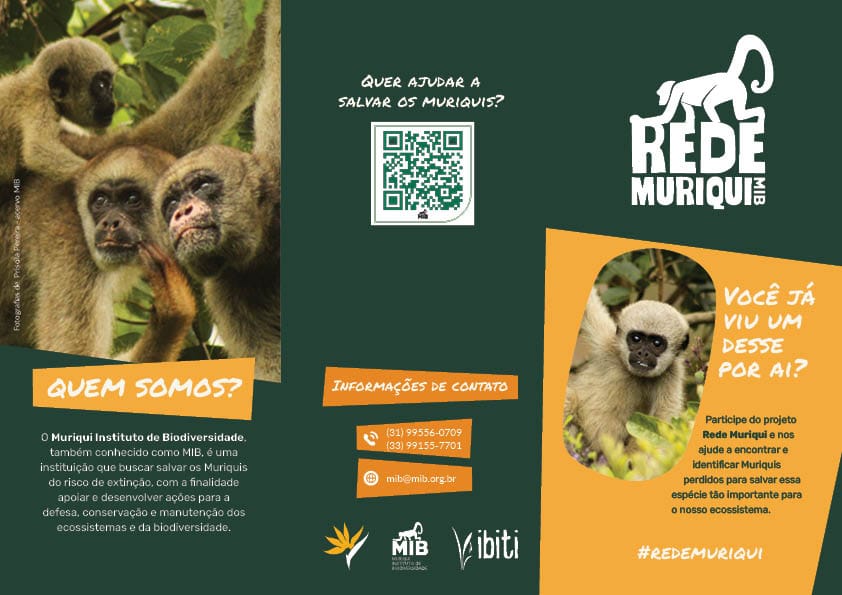
The SOS Muriqui program works as a direct channel between the communities living near the areas where muriquis live and our specialists. We distribute informational materials and an institutional contact — reachable by phone, WhatsApp, website or social media — to make communication easier. Anyone who sees or suspects the presence of an isolated muriqui can get in touch with us. Our team then goes to the site to confirm the animal's presence and, if necessary, carry out a rescue.
Where is SOS Muriqui headed?
This program is more than a communication channel: it is an important support for a national public policy called the Muriqui Population Management Program (Programa de Manejo Populacional dos Muriquis). The goal is to manage migrating muriquis, especially females found on their own, so that they can be safely translocated to other groups, ensuring the health and continuity of the populations.
Technology at the service of conservation
We know that a fast response is crucial to the success of SOS Muriqui. That is why we are developing an automated response service. This technology will let us reply to messages faster and streamline communication with communities, making the reporting and rescue process far more efficient.
How can you help?
Stay alert and help us protect the muriquis! If you live near areas where the species occurs or know people in these communities, share the SOS Muriqui contact. With your help, we can keep saving these incredible primates and ensure they have a future in the Atlantic Forest. Rede Muriqui and SOS Muriqui: citizen science and education to protect the largest primate in the Americas
A Protecting the muriqui — one of the largest and most threatened primates of the Atlantic Forest — depends not only on the efforts of researchers but also on the active participation of the communities living near these areas. With this in mind, the Muriqui Instituto de Biodiversidade (MIB) developed two key projects, Rede Muriqui and SOS Muriqui, united by the power of citizen science and environmental education.
Citizen science in practice: the birth of Rede Muriqui
It all began in 2017, when a yellow fever outbreak caused high primate mortality in Brazil's Southeast region, near the Reserva Feliciano Abdala. To monitor the situation outside the reserve, MIB created a citizen science project that mobilized 50 local families to record primate sightings and calls using a simple field form, the “perpetual calendar” — a wall calendar that anyone could easily fill in.
Building on the success of this model, which combined digital technology, social media, WhatsApp and printed materials, the initiative was expanded from Caratinga to the 12 areas where the northern muriqui occurs, covering around 50 municipalities. Rede Muriqui thus creates a true protection network, in which every record made by the community helps monitor migrating females and other individuals that need special attention.
SOS Muriqui: a rapid response to save muriquis at risk
Integrated into Rede Muriqui, SOS Muriqui is the channel that receives alerts from the public for rapid confirmation and, when necessary, the rescue of these isolated migrating muriquis. Today, the system relies on an institutional contact distributed through leaflets, social media and WhatsApp, enabling fast communication. And to improve the service even further, MIB is developing an automated chatbot to make the process faster and more efficient.
Environmental education: Rede Muriqui in schools
Beyond fieldwork, MIB knows that the best way to conserve muriquis in the long term is to invest in the next generations. That is why the Rede Muriqui project works in schools, mainly with fourth- and fifth-grade elementary school children, a key stage for receiving and embracing values about environmental conservation.
In schools, the project engages with students, teachers, school administrators and families, building a local communication network that complements urgent actions with deep cultural work. “There will be no trees or monkeys 20 years from now if this message isn't in these children's minds today,” as MIB's educators wisely say.
How to get involved and help
You can contribute too! If you live near areas where muriquis live or know people in these communities, share the contacts for Rede Muriqui and SOS Muriqui. Encourage children and adults to observe, record and report muriqui sightings, strengthening this great protection network.
Together, with citizen science, education and technology, we can secure a better future for the muriquis and the Atlantic Forest. Rede Muriqui: Environmental education in schools to secure the future of the muriquis
At Muriqui Instituto de Biodiversidade (MIB), we understand that conserving muriquis depends not only on immediate action in the field but also on raising a new generation that values and protects nature.
That is why the Rede Muriqui project invests heavily in environmental education in schools, especially with fourth- and fifth-grade elementary school children. This stage is considered ideal, as children are especially receptive to learning about the importance of preserving the Atlantic Forest and its primates.
In schools, the project engages with students, teachers, school administrators and families, creating a network of engagement and awareness that goes beyond the school curriculum. The goal is to plant the seed of conservation: preparing these children to become, 20 years from now, guardians of the forest and of the muriquis.
As one of MIB's educators puts it, “there will be no trees or monkeys 20 years from now if this message isn't in these children's minds today.” That is why investing in environmental education means ensuring that the future of the Atlantic Forest and the muriquis is in good hands.
You can also support this mission! Encourage environmental education in your community and help pass on the love for muriquis to future generations.