
Caratinga Primate Community Project
Population Monitoring and Conservation of a Primate Community in Brazil's Atlantic Forest
About the Caratinga Primate Community Project
This report consolidates the results of two consecutive projects dedicated to monitoring and conserving the primate community at the Reserva Particular do Patrimônio Natural Feliciano Miguel Abdala (RPPN-FMA), in Caratinga, Minas Gerais. The projects combined traditional monitoring methods with innovative technologies such as drones with thermal cameras and arboreal camera traps to expand our knowledge of brown howler monkeys, buffy-headed marmosets and black-horned capuchins.
Integrated Objectives
The projects aimed to deepen knowledge of group size, structure and population density of the three primate species, while testing the effectiveness of non-invasive technologies to improve monitoring. The fourth species, the northern muriqui, has been intensively monitored since 1983 by the team of the long-term Projeto Muriqui de Caratinga (Caratinga Muriqui Project).
Project Team
Coordinator Carla de Borba Possamai
Collaborator Marlon Lima
Collaborator Karen B. Strier
Long-Term Outlook
The consolidated results show that primate populations can recover from catastrophic events such as yellow fever outbreaks when suitable habitats are maintained and rigorous scientific monitoring is in place. The successive integration of technologies offers a replicable model for the conservation of Neotropical primates.
Evolving Methodology
We carried out six expeditions totaling 81 field days using conventional monitoring methods. We conducted 14 censuses, walking 44.2 km, and included an international internship program with a French student to habituate marmosets.
Technology Phase (2023-2024)
We expanded to 125 field days, integrating non-invasive technologies. We carried out 149 drone flights and placed six arboreal camera traps in the tree canopy, complementing 7 additional censuses covering 21.8 km.
Technological Innovations
Drone Monitoring: Of the 149 flights carried out, 72 (48%) were based on prior information and 77 (52%) were exploratory flights. Muriquis were detected on 42 flights, capuchins on 11 and brown howlers on 9.
Arboreal Camera Traps
We obtained 34 records of capuchins, 37 of muriquis, 4 of brown howlers and 1 of a buffy-headed marmoset, as well as other arboreal species.
Consolidated Results by Species
Brown howler monkeys (Alouatta Guariba)
Phase 1 (2022-2023): We relocated 11 of the 13 known groups, totaling 62 individuals: 33 adults, 22 immatures and 6 infants. Mean group size: 5.16 ± 2.24 individuals.
Phase 2 (2023-2024): We identified 25 groups from 79 records and systematically monitored 16 of them. The main groups totaled 69 individuals: 43 adults, 17 immatures and 6 infants. Mean group size: 4.31 ± 1.40 individuals.
The population shows signs of stability, with evidence of recovery after yellow fever, although mean group size decreased slightly between the two periods.
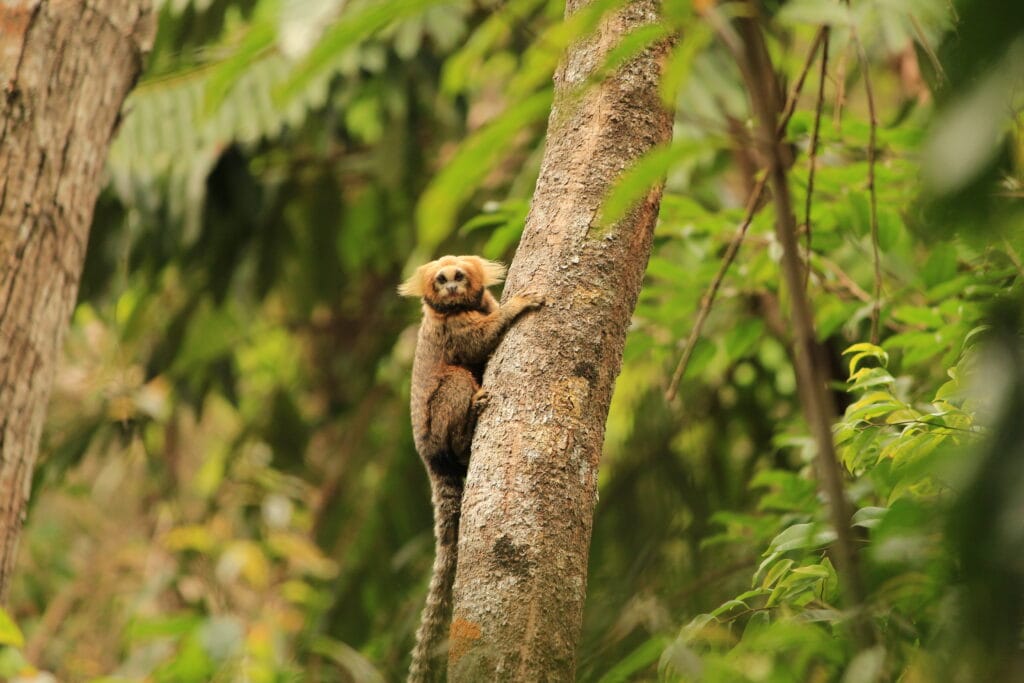
Buffy-headed marmosets (Callithrix flaviceps)
Significant Progress: The population grew from 17 to 32 individuals in 2022-2023, a remarkable recovery after the yellow fever outbreak. In the second phase, we relocated known groups and recorded a possible new group.
Home Range Data:
- Group II: 118 hectares (core area: 27 ha)
- Group IV: 36 hectares (core area: 5 ha)
Signs of Reproduction: We observed reproduction in multiple groups for the first time since the yellow fever outbreak, indicating exceptional population resilience.
Black-horned capuchins (Sapajus nigritus)
Phase 1: We identified at least 6 groups/subgroups with 44 individuals (22 adults, 17 immatures). Mean size: 7.33 ± 3.27 individuals.
Phase 2: We recorded at least 6 groups ranging from 6 to 12 individuals across 56 observations. The population maintains a female-biased sex ratio and shows recent signs of reproduction.
The population shows consistent stability, with favorable conditions for long-term survival.
Effectiveness of Innovative Technologies - Methodological Comparison
Traditional Methods: Effective for detailed demographic data and habituation, but limited in time and area coverage.
Non-Invasive Technologies: Drones proved particularly useful for locating lost groups and covering large areas. Camera traps provided continuous data with minimal human interference.
Identified Limitations
Drone detections are most effective on cold mornings and cloudy days. Brown howlers are harder to detect when clustered in the understory. Dense vegetation significantly reduces the effectiveness of both technologies.
Challenges and Adaptations
Environmental Conditions
Heavy rains (December 2022 – February 2023) blocked trails with dense vegetation and fallen trees, limiting traditional censuses. We adapted our strategies, prioritizing remote technologies during adverse conditions.
Population Density
The low number of howler and marmoset sightings reflects lower densities after yellow fever. Density estimates require cautious analysis due to the limited sample size.
International Training Program
Hugo Leroy's internship (France) made a significant contribution to: - Pre-habituation of marmoset Group IV; - Detailed home range data for two groups; - Strengthening international collaborations; - Transfer of knowledge on field techniques.
Overall Population Recovery
Brown howler monkeys: Clear evidence of recovery, with larger group sizes and active reproduction.
Buffy-headed marmosets: Exceptional recovery, with the population nearly doubling and reproductive activity resuming.
Black-horned capuchins: Stable, healthy population with consistent reproduction.
Success Factors
– Effective habitat protection at the RPPN-FMA
– Continuous monitoring enabling timely interventions
– Integration of technologies increasing data collection efficiency
– International collaborations strengthening scientific capacity
Signs of Ecological Recovery
Implications for Conservation
Validated Strategies
Long-term monitoring confirms the effectiveness of protecting well-preserved forest fragments for the recovery of threatened primate populations. Combining traditional methods with innovative technologies offers a robust approach to conservation.
Future Recommendations
- Expand the camera trap network using a grid system
- Develop standardized protocols for using drones in primate monitoring
- Step up international scientific exchange programs
- Apply validated methodologies in other Atlantic Forest fragments
Ongoing Scientific Commitment
This work represents a long-term commitment to securing a sustainable future for emblematic species of the Atlantic Forest. Ongoing collaboration between Brazilian and international institutions is essential to address emerging challenges in the conservation of threatened primates.